
Cleanup Bookkeeping Case Study: 19-Property Rental Portfolio
QuickBooks Online Plus · 2025 Cleanup · January–May 2026 Catch-Up · Monthly Bookkeeping
Project Overview
| PROJECT AT A GLANCE |
|---|
| 19 rental properties organized for property-level reporting |
| 17 months of bookkeeping completed across 2025 and 2026 |
| 5 mortgage loans reconciled with principal and interest broken out |
| 1 checking account and 3 credit card accounts reconciled |
| Gross rental income broken out from net property manager deposits |
| Property expenses and management fees reported separately from rental income |
| Monthly bookkeeping began after the cleanup |
A real estate investor and landlord came to Bookkeep Boss with 19 rental properties that had outgrown a simple categorized transaction approach. The portfolio had reached a level of complexity that required more detailed records, reconciliations, and reporting than their current bookkeeper was able to provide.
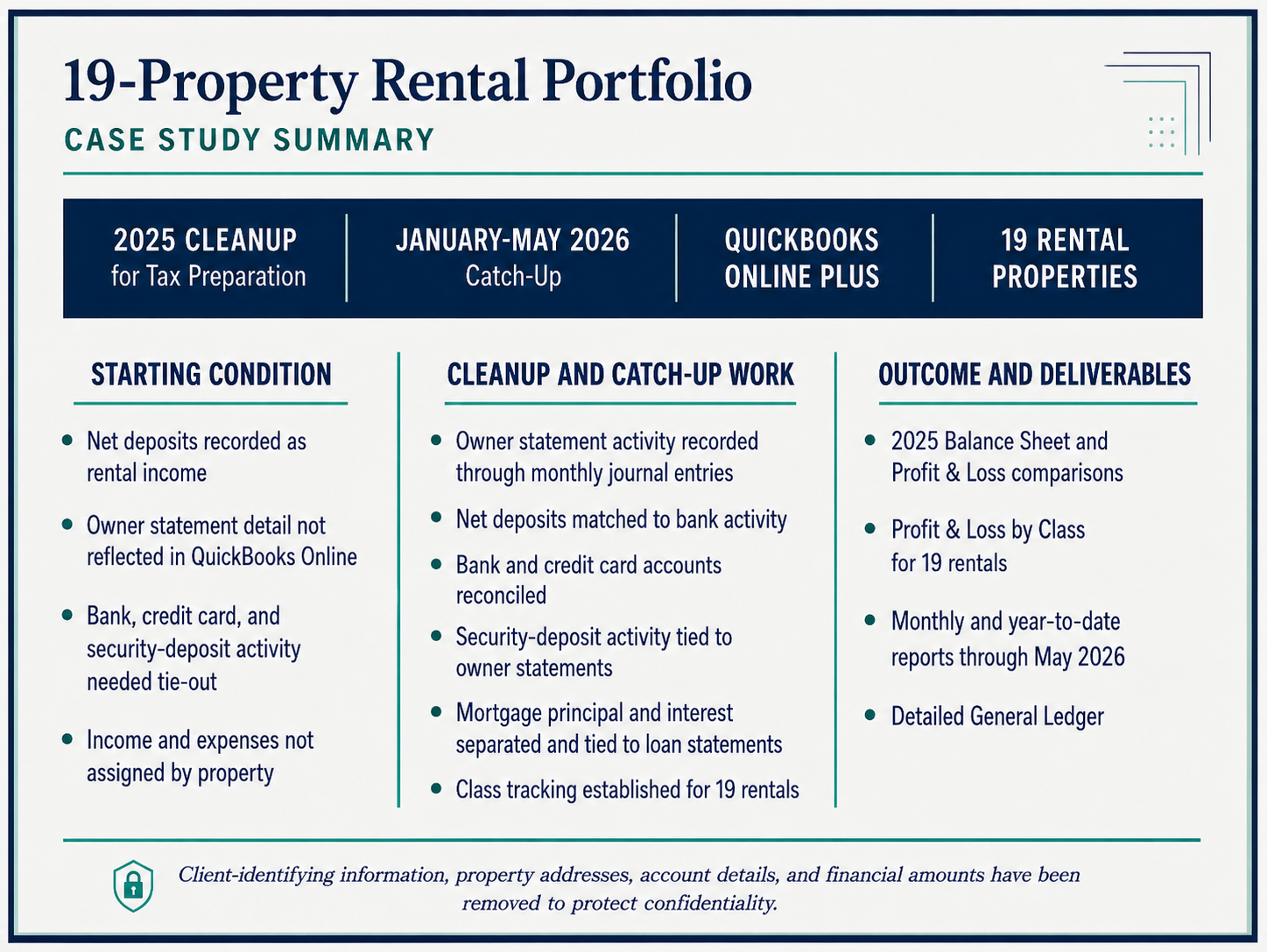
When we opened the QuickBooks Online file, the owner could see deposits from the property manager, but not the rental activity behind those deposits. Because the net deposits had been recorded as rental income, the books could not show gross rents, management fees, property expenses, or security deposit activity by property.
The owner could see money coming in, but the books did not give them a clear view of what was actually happening across the portfolio.
They needed rental property bookkeeping in QuickBooks Online that could show activity across the full portfolio, including income and expenses for each property, along with financial reports their tax professional could use for tax preparation, tax planning, and ongoing portfolio management.
The project involved cleaning up the 2025 QuickBooks records, bringing the file current through May 2026, reconciling one bank account and three credit card accounts, separating principal and interest for five mortgage loans, reviewing security deposit balances against owner statements, and establishing property-level reporting across all 19 rentals.
Introductory Call
The process began with an introductory phone call to discuss the client’s 19-property rental portfolio, their current QuickBooks setup, bookkeeping situation, and reporting needs for tax preparation, tax planning, and ongoing portfolio management.
The purpose of the call was to understand their situation at a high level and identify the next step. Based on the size of the portfolio, the property manager activity, and the reporting the owner needed, the cleanup scope and pricing could not be determined from the introductory call alone. The client moved forward with a paid Bookkeeping Review.
Bookkeeping Review & Roadmap
The paid Bookkeeping Review established the starting condition of the bookkeeping and defined the cleanup scope.
Before proposing cleanup work, Bookkeep Boss reviewed the QuickBooks file, property manager's owner statements, bank activity, credit card activity, loan activity, and supporting records already uploaded. Those records included receipts and purchase confirmations stored through the QuickBooks receipts feature.
Using a reconciliation-focused approach, the review compared QuickBooks activity and balances with property manager's owner statements, bank statements, credit card statements, loan statements, security deposit activity, and supporting documentation.
This comparison identified transactions, account balances, and reporting gaps that needed reclassification, reconciliation, correction, or further review during the cleanup.
The review identified that:
- Net deposits received from the property manager had been recorded as rental income without showing the gross rental income, property management fees, property expenses, and security deposit activity reflected on the owner statements.
- One bank account and three credit card accounts had not been reconciled since the prior year.
- Security deposit balances did not tie to the property manager's owner statements.
- Some security deposit balances related to tenants who had moved out were still showing on the Balance Sheet.
- Monthly payments for five mortgage loans needed to be separated between principal and interest.
- Income and expenses were not assigned by property.
- Property-specific expenses were blended with broader operating expense accounts.
- The owner did not have a Profit & Loss report for each of the 19 rental properties.
The review confirmed that the cleanup needed to address both account activity and the reporting structure. Activity from the property manager’s owner statements needed to be reflected on the Balance Sheet, account balances needed to be tied to source records, and income and expenses needed to be assigned by property.
This made it necessary to establish a property-level reporting structure across all 19 rentals, correct the 2025 historical activity, and complete the January through May 2026 catch-up work using that structure.
The completed review provided the detail needed to define the cleanup scope and pricing, along with the monthly bookkeeping scope and estimated monthly pricing presented to the owner during the results call.
Findings, Scope & Pricing
Once the Bookkeeping Review was complete, we emailed the findings report, pricing sheet, and a copy of the Balance Sheet to the client. The findings and pricing were then discussed during a results call.
The call covered the condition of the QuickBooks file, the source documents reviewed, the 2025 cleanup work, the January through May 2026 catch-up work, the sequence of work, the cleanup pricing, and the estimated monthly bookkeeping scope and pricing.
By reviewing the findings report and Balance Sheet during the call, the client could see why the project included recording the full activity shown on the property manager’s owner statements, reconciling bank and credit card accounts, correcting security deposit balances, separating mortgage principal and interest, and establishing property-level reporting. The call also explained why the January through May 2026 catch-up work needed to be completed before monthly bookkeeping began.
The findings, approved scope, and work sequence from the results call became the basis for the cleanup and catch-up work described below.
How the Client Moved Through the Process
Introductory Call → Paid Bookkeeping Review & Roadmap →
Findings, Scope & Pricing → Results Call →
Approved Cleanup Work
Cleanup and Catch-Up Work Performed
With the cleanup scope approved, the findings report became the roadmap for the work. The cleanup began with the 2025 bookkeeping activity.
The work started by reviewing and classifying bank feed activity for the checking account and credit cards.
We referred to the property manager’s owner statements to record monthly journal entries in QuickBooks that reflected the activity behind each net deposit. This included gross rental income, property management fees, property expenses, and security deposit activity shown on the owner statements.
The net deposits sent by the property manager were then matched to the related bank feed activity. This connected the cash received by the owner to the underlying rental activity without recording rental income twice.
Using a reconciliation-focused approach, we reviewed the Balance Sheet and worked through the accounts that needed to be reconciled, corrected, or tied to supporting records.
The cleanup and catch-up work included:
- Reviewing security deposit activity against the property manager’s owner statements and reconciling the related Balance Sheet balances.
- Separating the principal and interest portions of monthly payments for five mortgage loans and reconciling the loan accounts.
- Using receipts, purchase confirmations, and other available records to assign property expenses to the correct rental.
- Establishing class tracking in QuickBooks Online Plus for all 19 rental properties.
- Reconciling one bank account and three credit card accounts against the related statements and transaction activity.
By completing the 2025 cleanup first, the January through May 2026 catch-up work could be completed using the new property-level reporting structure.
Outcome and Deliverables
After the cleanup and catch-up work was completed, the client received updated QuickBooks records through May 2026, reconciled bank and credit card accounts, reporting by property for all 19 rentals, and financial reports for review with their tax professional.
The completed Profit and Loss report showed the activity behind the net deposits received from the property manager. Gross rental income, property management fees and property expenses from the property manager’s owner statements were recorded separately. The mortgage payments were separated between principal and interest, security deposit liability balances were updated on the Balance Sheet, and receipts and purchase confirmations were attached to related transaction activity when available.
With the cleanup, catch-up work, and property reporting structure in place, the client received the following financial reports.
Financial Reports Delivered
2025 Reporting Package
The completed 2025 reporting package included:
- Balance Sheet with prior year comparison
- Profit & Loss with prior year comparison
- Profit & Loss by Class, with each class representing a rental property
- Detailed General Ledger for tax preparation review
2026 Reporting Package
The January through May 2026 reporting package included:
- Monthly Balance Sheets with prior year comparison
- Year to Date Balance Sheet with prior year comparison
- Monthly Profit & Loss reports with prior year comparison
- Year to Date Profit & Loss report with prior year comparison
- Monthly Profit & Loss by Class reports
- Year to Date Profit & Loss by Class report
Together, the reports gave the owner reconciled account activity, reporting by property for all 19 rentals, portfolio level reporting for both periods, and a property level reporting process that could continue into monthly bookkeeping.
Monthly Bookkeeping After Cleanup
After the cleanup and catch-up work, the client moved into monthly bookkeeping using the property-level setup established during cleanup.
Each month, Bookkeep Boss records activity from the property manager’s owner statements through a journal entry, matches net deposits to bank activity, reconciles accounts, separates mortgage principal and interest, reviews security deposit balances for tenant move-ins and move-outs, assigns transactions by property, and prepares portfolio-level and property-level financial reports.
This process maintains the connection between the source activity on the owner statements, the account activity in QuickBooks Online, and the reports used by the owner and tax professional.
How Bookkeep Boss Approaches Client Work
Bookkeeping Review First → Reconciliation
Focused Cleanup → Monthly Bookkeeping
About This Case Study
This case study reflects actual real estate investor bookkeeping work completed by Bookkeep Boss in a client’s QuickBooks Online file for a 19-property real estate portfolio.
The work followed a reconciliation-focused approach. QuickBooks account activity and Balance Sheet balances were compared with available source documents, including owner statements from the property manager, bank statements, credit card statements, loan statements, security deposit activity, receipts, purchase confirmations, and documentation uploaded through the QuickBooks Online receipts feature or emailed directly to Bookkeep Boss.
The work described included bookkeeping, account reconciliations, property-level reporting, financial report preparation, and bookkeeping reports prepared for handoff to the client’s tax professional. It did not include tax return preparation, tax advice, legal advice, audit services, or assurance services. Tax treatment and filing decisions remained with the client’s tax professional.
This case study also highlights the Bookkeep Boss client experience, which moved from an introductory phone call to a paid Bookkeeping Review & Roadmap, Findings, Scope & Pricing Call, cleanup and catch-up bookkeeping, and monthly bookkeeping.
This case study shows how a review-first, reconciliation-focused bookkeeping process can turn complex QuickBooks Online records into organized financial reports for tax preparation and portfolio review, while creating a path into ongoing monthly bookkeeping.
Related Resource: See a sample CPA-ready monthly bookkeeping close summary.
Prepared by Laura Parker
Co-Owner & Bookkeeping Lead
Bookkeep Boss
Intuit QuickBooks Certification Level 2
Learn More About Laura
Ready to Discuss Your Bookkeeping Needs?
Schedule an Introductory Call to discuss your current QuickBooks Online records and reporting needs.
A short conversation to confirm fit and walk through the next step, including the Bookkeeping Review & Roadmap.